Tag: Mythology

  • Lord Vishnu’s reassurance to Narada Muni

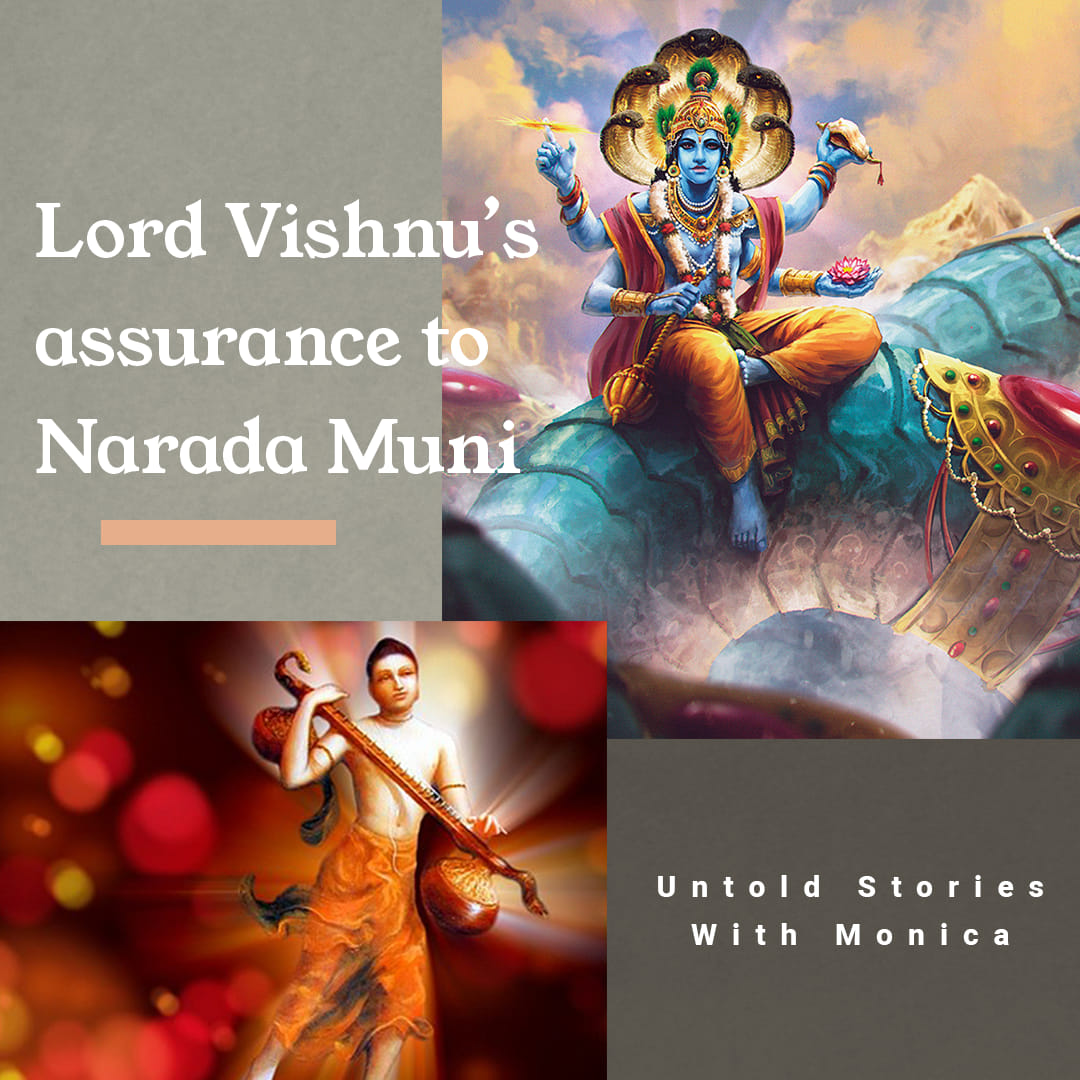
    Lord Vishnu’s reassurance to Narada Muni

    “Narayana! Narayana!”

    Hearing the words and recognizing the speaker, Lord Vishnu’s faint smile broke into a grin as he lay rested in Vaikunth. Narad Muni walked in and paid his reverence. Knowing of Narad muni’s notorious nature, Vishnu used his divine power to peep into his mind to know of the purpose behind his visit. After having received an insight, Vishnu placated and pampered him with his words,

    “You look restless and disturbed, Narad. Who has dared to bother my most favourite devotee?”

    Hearing the phrase, ‘most favourite’ brought a spark in Narada’s eyes.

    “You are calling me your favourite devotee! Look below, all over the Earth, humans are building Hanuman’s temples. Every temple of yours is complete when his statue is placed near your feet. They are calling him, “The Parm Bhakta”. No one remembers me! They don’t see that I recite your name, Narayana, with every breath. They are calling Hanuman your most loving Bhakta!” He shrugged his head in dismissal.

    Lord Vishnu was moved by his words. He could sense his baseless insecurities. He was used to such instances when his devotees got into similar comparisons among themselves. He loved them all equally and knew the art to tackle their temporarily affected state of mind.

    Lord Vishnu eased him,

    “Yes! You certainly are my loving, favourite devotee Narada. But so is Hanuman. Isn’t this comparison like cheese and chalk? Tell me, the wise one. Everyone who recites my name with reverence shares the same place in my heart, there aren’t any pedestals there, my dear.”

    “Yes! It may be, my Lord. But why aren’t I so glorified as Hanuman on Earth?” sulked Narada.

    Laughing at the childlike behaviour of Narada, Vishnu reasoned,

    “This is because while I incarnated as Ram with a purpose to establish the new Dharma, I needed people to support me in that cause. I was born as a human, hence I wasn’t self-sufficient. When I was roaming like a nomadic in the forest in search of Sita, Hanuman came forth and guided me. He utilized his superpowers to support a worthy cause. He used his network of Vanar community to build an army to bring down the mighty Asura, Ravana. His courageous choice

    of actions had to be glorified, to exemplify the strength in unity, and how one must use his talents and power for a higher cause. Also, the new Yug had to be presented with new personality traits for the formation of a wholesome society.”

    Forgetting his insecurities for a while, Narada prompted,

    “And what were they?”

    Vishnu continued,

    “Hanuman was a personification of the extraordinary quality of inner-self-restrain. It reflected in his practice of Bal Brahmachari, attained with the practice of meditation. Despite being a supreme power himself, Hanuman was the most humble and modest person. His selflessness had to be showcased. He never expected any returns or glorifications for his favours and work. He simply chose to be with me forever, to be my backbone, to be the land underneath my feet. That’s humbleness and selflessness. These traits of his had to be exemplified so that humans would imbibe them.”

    Vishnu’s words evoked feelings of respect for Hanuman in Narada’s heart.

    “Hanuman is indeed godly in doing so and being so!” Praised Narada.

    “And so are you my dear!” added Vishnu.

    “Hanuman guided me while I was on Earth. And you when I was in Vaikunth, as a Trimurthi, as the sustainer of life. You roamed around in the Triloaks (three worlds) repeating my name, “Narayana, Narayana”. If not that, how would my popularity become a reality among Devas, Asuras, Manav (human) and every other living entity. You travelled along with my stories everywhere, sang songs of me, and repeated my name before all. Thus making me famous and establishing me as the Palanhaar of the universe. If not by you, who would know Narayana, the Vishnu, the Preserver, my dear? Coming to temples, they are structures built to keep humanity reminded of its human duties and follow the right path to perform their Karma. You reside in my heart Narada, that’s your temple. Everyone who bows before me, bows before you as well, Munivar.”

    Vishnu’s words assured Narada of his position and glory. He clicked on his Khartal (musical instrument) and struck the strings of his Tanpura and resumed on his journey merrily singing and reciting, “Narayana! Narayana!”
  • Bhanumati shares her heart with Lakshmana (Daughter)

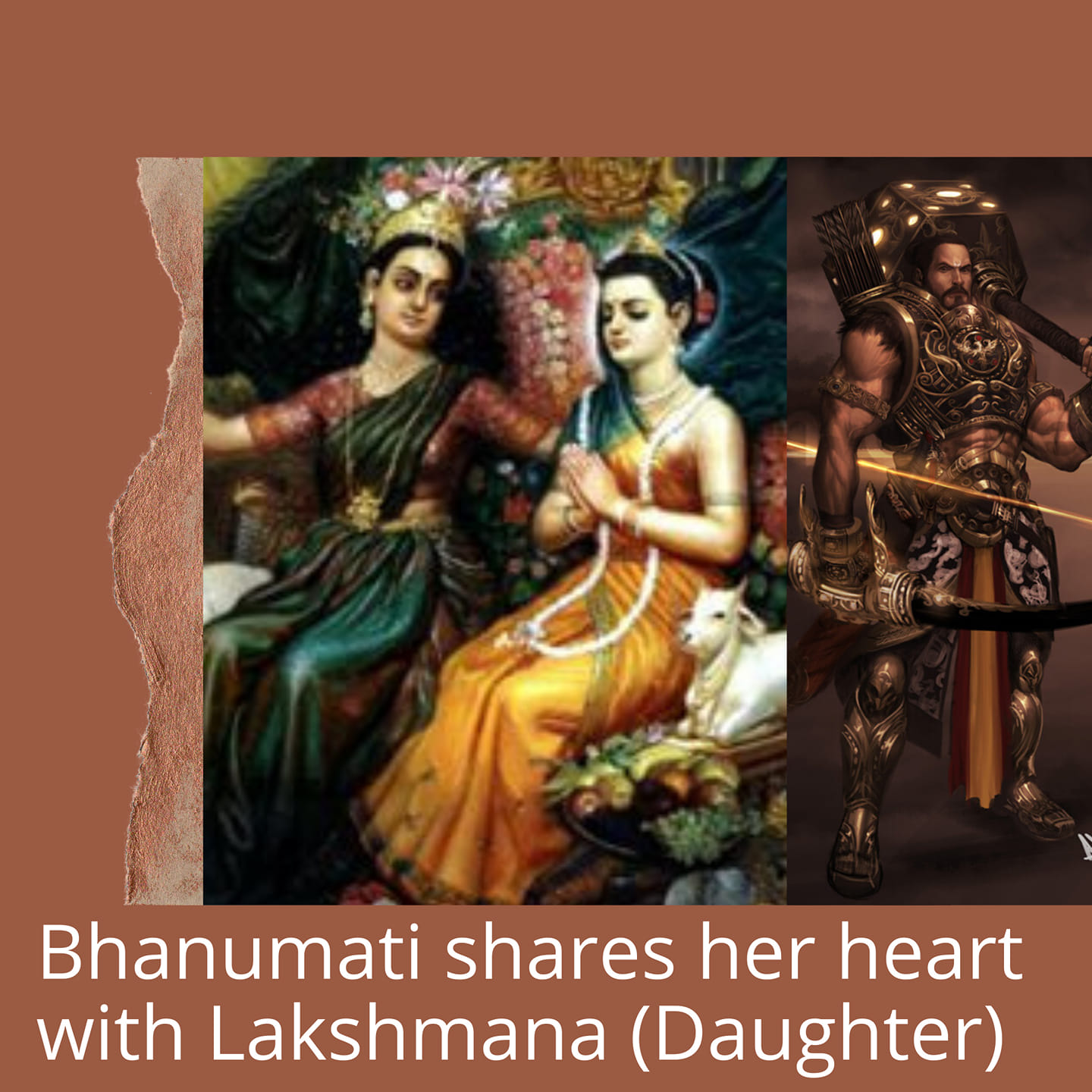
    Bhanumati shares her heart with Lakshmana (Daughter)

    From the squint of her eye, Bhanumati could see through Lakshmana’s heart. She bore much resemblance to her father, Duryodhan. Just like him, her gait spoke of her emotional state. Holding her wrist, and running a loving palm on her cheeks, she asked,

    “What thought is keeping my daughter so occupied that she doesn’t even see her mother in the chamber?”

    Lakshmana’s eyes ran over Bhanumati’s face. Devoid of adorations, pristine and white. She lowered her eyes, feeling the pang of the void that the death of her father had left in their heart.

    “Maa! Life has been very difficult for you and it still is.” empathized Lakshmana.

    Faking a smile Bhanumati asked,

    “What makes you say that?”

    “Maa, the world saw my father, Duryodhan, as a villain. The history of Hastinapur and Mahabharata writes him as an antagonist, adharmic. His death is grieved less and more joyed. It must have affected you, right?”

    “Yes, it did! It did for a while. It affected the queen of Hastinapur, not his wife. He was an Adharmi in the eyes of the moralists. He was a villain in the eyes of his enemies. He was an antagonist for those with whom his ideologies were in a clash. History writes him only through the ink of his political career, his defeat and his misdeeds.”

    “And how do you see him, mother?” Lakshmana prompted.

    “I see him through the eyes of a wife. He was the most loving man. A man with tough shoulders and a soft heart. When he had forcefully abducted me from the Swayambar, I was furious and hated him to the core. But when he politely bared his heart, expressing his love for me at first sight, when he had reasoned that my abduction was the only resort left to him and that he didn’t want to lose me to anyone, I was able to see his intentions and not judge his actions. He married me only after winning my love. He had wooed me for days, had won my trust and promised to be a one-woman man all life. And he did too. He was a gentleman, true to his love and soul.”

    “You call him a gentleman, even though he called Mata Draupadi names and mistreated her publicly in vulgar ways?”

    “Yes, I was angry, very angry. I had lashed at him for doing this to a woman. My blood had boiled. But he had sternly reasoned that it was a political move, an act of vengeance against her mocking and bullying him, calling him a blind man’s son. A repercussion Draupadi faced for using her tongue loosely.”

    Bhanumati continued,

    “Lakshmana, however, the history might portray him, but to me, his wife, he will always be a hero, the victorious king of my heart. Although the world saw him as an egoist, I knew that his ego was a defense against the unfair world. Also, your father was merely a pawn in the hands of his maternal uncle Shakuni, who harbored grievances against Hastinapur and Pitamaha Bhishma and used your father to seek his revenge.”

    “Didn’t his short temper or reactive nature ever scare you and keep you edgy?” intrigued Lakshmana.

    “Initially it did. When I saw him behave like that with others, it feared me. But as years passed, I realized my fears were irrelevant. For he was never that to me or to the people he loved. I recall this incident. Once he was away at war for a few days. He had asked Karan to keep me company and take care of me. I and Karna were lost in playing a game of dice, I was on the losing side. So I was irritated and got up to leave for quits. But Karan grabbed my wrist to stop, asking to complete the game. In doing so my long pearl necklace, entangled in his hand and it broke, scattering the beads all over. At that instant, your father entered. I and Karna were taken aback. We felt Duryodhan may misunderstand and misjudge us. But to our surprise, he picked up all the pearls and joked, “Should I bead them too?” after that incident, my fears were gone. I had a glimpse of his heart that was filled with faith for his wife and his friend.”

    Seeing her father through the eyes of her mother, Lakshmana realized that a man can never be painted in just black or white, that there were reasons to justify his father’s actions. She hugged her mother tight. Her chest bloated with pride for her father. She walked out of her mother’s chamber with a light heart, as silent tears of love trickled down Bhanumati’s eye.

  • VED VYAS’S REASONING TO VRISHKETU

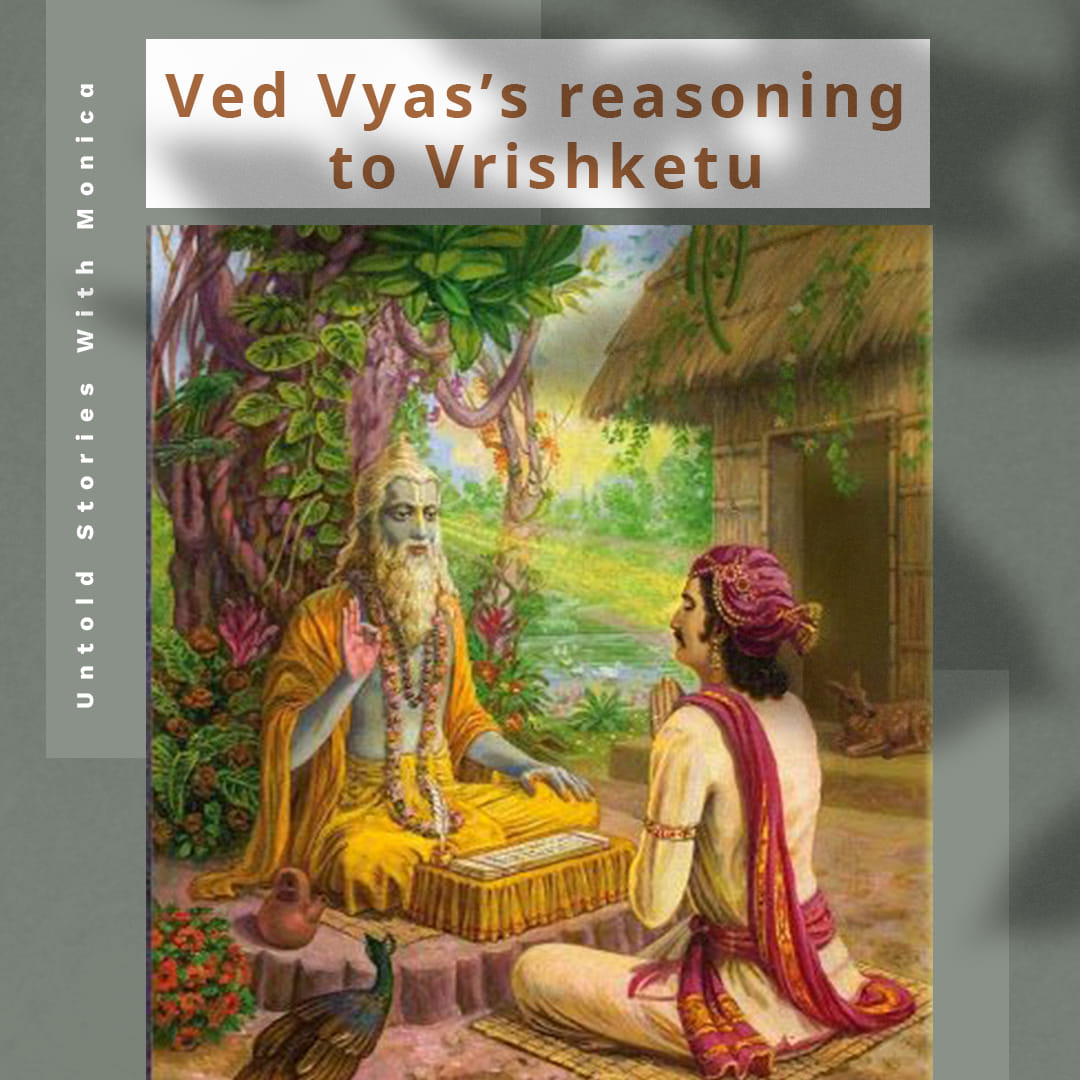
    VED VYAS’S REASONING TO VRISHKETU

    “Pranam, Gurudev!” Vrishketu reverentially bowed before Ved Vyas, the legendary author of the epic Mahabharata.

    “Gurudev, the world is well versed with my father, Karna’s story. Today, I am his only surviving son. I have seen my father and all my brothers killed in the Kurukshetra war. I also saw how my father’s death was brought about. Gurudev! You are an immortal, the witness and the writer of this epic tale of Hastinapur. I seek the light of your wisdom to clear the darkness of confusion that looms over my father’s demise.”

    Ved Vyas raised his hand to bless Vrishketu. As if he could read his mind and preempt the questions that bothered him, he nodded with a faint smile,

    “Ask Vatsa (disciple)… Tell me what confuses you?”

    “I don’t understand why was my father cursed even when his intentions weren’t bad? He hid his identity from Lord Parshuram only in the quest to learn, to gain knowledge. And as we know, the cow was killed by him accidentally, not intentionally. And yet he was cursed with words that eventually led to his defeat and death. Isn’t this unfair and unreasonable? And how can someone’s words be so powerful that they bring down someone’s life, that too, a legend’s life?” Vrishketu asked in anger and sadness.

    After a thoughtful moment, Vyas replied,

    “Putra, there are two paths to reach the answers to your question. One is, the understanding that it was – Karna’s destiny. Destiny always designs the path as per the chosen destination. And to do so, it paws on people and circumstances. Karna sided adharma, he stood by the Kauravas. Pandavas, on the other hand, represented dharma. And as you know, to establish dharma, adharma had to be abolished. Although Karna was a divine child of the Sun God and an outstanding and a skilled archer, he supported adharma. Hence, destiny had to remove him. To do so, it used Lord Parshuram’s and the Brahmin’s curses as its medium. This is one way to understand why things turned against your father. It was destined!”

    “So that means, we mortals are like puppets tied to the hands of Destiny. And what is the second explanation behind his defeat?” asked Vrishketu, listening attentively.

    “The second path to understanding the tragedy of your father is to analyse his personality. Karna’s persona and choices led him to his doom. Ever since his birth, he was unable to build a strong personality. His persona was developed based on others’ perceptions and opinions of him. He was greatly affected and moved by how the society saw him and spoke of him. That’s why he rebelled against everyone – whoever called him a ‘Sut Putra’. He made Arjun his biggest rival for no personal reason, but because he always felt that Arjun was more popular and more loved by all. Resulting in jealousy and envy. He blindly pivoted his life on defeating Arjun to prove himself to the world.”

    “What’s the harm in centring one’s life to one goal?” interrupted Vrishketu.

    “Life is like a wheel. For its smooth momentum, the weight should be evenly distributed. But like Karna, when an individual exerts all the pressure on just one aim, the wheel of his life is bound to get stuck at some given point. Just as it happened during the Kurukshetra war, the wheel of his chariot was stuck in the mud. It symbolised the fact that Karna had put the weight of his entire life to defeat Arjun. Consequently, when the most awaited moment of life arrived, the feeling of overwhelm lead to a blackout. He had eagerly waited for the moment to defeat Arjun. And when it happened, his mind went blank; because after that moment would have passed, Karna’s life would become purposeless.”

    Choked with emotions, Vrishketu asked,

    “And how were his choices responsible for his tragedy, Gurudev?”

    “He always chose to see the darker shades of his life. He hung on to people’s mockery and indulged in self-pity that eventually generated frustration. To explain better, I will draw a parallel example of Krishna. Even Krishna was given away by his parents. His birth was shadowed by death. Although born a prince, he was raised as a cowherd. Even he was accused and mocked often as a Makhan chor, and as a shrewd politician. He didn’t master in any major weapon skills. But unlike Karna, his strength lay in acceptance, in swimming with life’s flow. And that’s what his weapon, Sudarshan Chakkar is symbolic of. The movement of life’s chakkar is the strongest weapon to fight against any challenges. To flow and not resist. Karna’s inability to laugh at life, to accept circumstances, to see the brighter side made him bitter. Unlike Krishna, he was driven by emotions and not objectives. He chose Duryodhan based on emotions, not reasons. And that was a wrong choice.”

    Deeply contemplative, nodding at the insightful reasons cited by Ved Vyas, Vrishketu touched his feet and walked back with much more to ponder upon.

  • SITA SPEAKS TO HER SAKHI (FRIEND)

    Standing before the mirror, Sita ran her fingers through her cascading hair.

    “Look at that lovely hair! I have always envied you for them.” Joked Sita’s Sakhi as she walked into her chamber in Swarg loak.

    Surprised by the unannounced arrival, Sita reached out to hug her beloved Sakhi. Seating with her on the couch she bemused,

    “What a pleasant surprise! How have you been Sakhi?”

    “What can possibly be wrong with me, who has a friend like you?” Sakhi replied with pride.

    Having met after a long time, they both exchanged pleasantries, enquiring about each other’s well-being. Sakhi then stood up and walked around the chamber thoughtfully. Sita’s gaze followed her. Comprehending that her Sakhi had something to say but was hesitant to do so, Sita touched her Sakhi’s shoulder.

    “Sakhi, please speak your heart. You can share anything with me, dear. Isn’t that how friends are?” Eased by her words, Sakhi placed her hand on Sita’s.

    “Sita, we all know that during your exile years with Lord Ram, you were abducted by Asura Ravana. We all know about the atrocities inflicted on you. The trauma you went through. But there has been a thought that has always made me wonder. Was it really an abduction or your will in disguise?”

    Stirred by the question, Sita began fidgeting with her dress. She countered it with another question.

    “What makes you see my abduction as a disguised Will Sakhi?”

    “At the tender age of 9 years, Sita you could lift the supreme Pinaka (the bow of Shiva). The same bow, at your Swayambar, Mahabali Ravana, in his prime and powerful youth, couldn’t even move, forget about lifting it. Isn’t this evidence enough of your Shakti?… Of your supremacy over him?….. And when he came to kidnap you, all you did was push him?…. You were obviously more powerful. Then why did you allow it to happen? You could have easily reduced him to dust there and then. Even after having read all the scriptures on Ramayana, written by great sages, this mystery remains unresolved. Only you can open your heart and answer this. I am here to hear it from you.” Smiling as her Sakhi’s smartness, Sita replied,

    “Yes! It was a disguised will. For my Dharma then, was not to fight but to be the Shakti of Lord Ram….  For it was not my purpose of descending on Earth…. That purpose was Ram’s, Vishnu’s avatar to abolish the asuras, and lay the foundation of a cultivated form of society…. To kindle the new Dharma of righteousness….. My purpose was to be the reason behind the action, not the action itself Sakhi. If I had not been abducted, 

    How would the legendary Jatayu prove his devotion to me and Lord Ram? 

    How would the Vanaras (The animal community) rise above their animal instinct and fight for justice? 

    How would Vibhishana practice the choice between right and evil? 

    And above all, how would Lord Ram, born as a Kshatriya find a rightful reason to annihilate demon Ravana? 

    For according to Kshatriya Dharma, without an evil deed, a weapon can’t be raised against an enemy. So my dear friend, though I was a Shakti, the manifestation of my power lay, in supporting my Lord Shri Ram. To amalgamate my powers with him and fulfill our purpose of incarnation.”

    Having received a satisfactory answer to her burning curiosity, the Sakhi happily hugged Sita. Her eyes glistened with tears of undying love and pride more than ever.