Category: Mythology

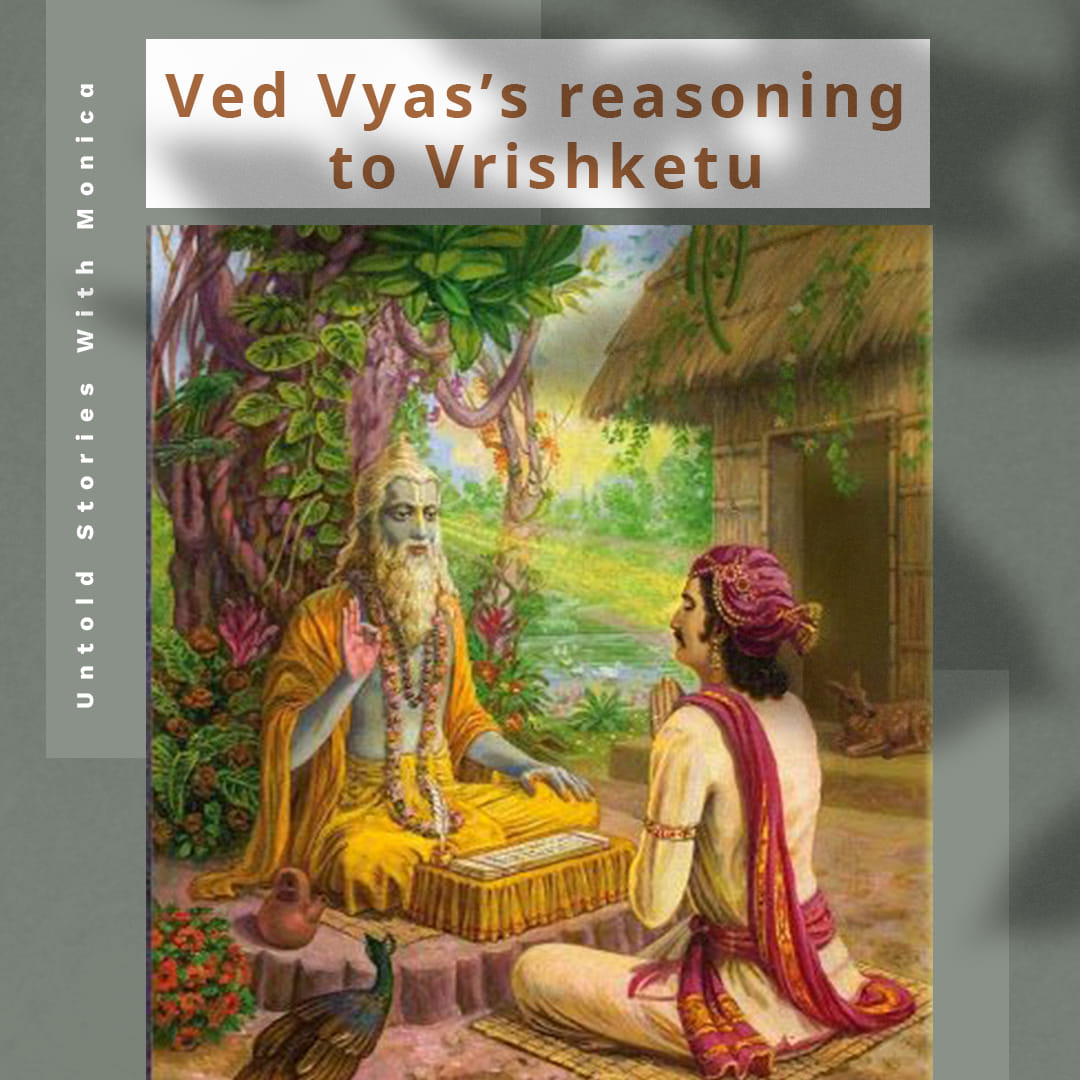
  • VED VYAS’S REASONING TO VRISHKETU

    VED VYAS’S REASONING TO VRISHKETU

    “Pranam, Gurudev!” Vrishketu reverentially bowed before Ved Vyas, the legendary author of the epic Mahabharata.

    “Gurudev, the world is well versed with my father, Karna’s story. Today, I am his only surviving son. I have seen my father and all my brothers killed in the Kurukshetra war. I also saw how my father’s death was brought about. Gurudev! You are an immortal, the witness and the writer of this epic tale of Hastinapur. I seek the light of your wisdom to clear the darkness of confusion that looms over my father’s demise.”

    Ved Vyas raised his hand to bless Vrishketu. As if he could read his mind and preempt the questions that bothered him, he nodded with a faint smile,

    “Ask Vatsa (disciple)… Tell me what confuses you?”

    “I don’t understand why was my father cursed even when his intentions weren’t bad? He hid his identity from Lord Parshuram only in the quest to learn, to gain knowledge. And as we know, the cow was killed by him accidentally, not intentionally. And yet he was cursed with words that eventually led to his defeat and death. Isn’t this unfair and unreasonable? And how can someone’s words be so powerful that they bring down someone’s life, that too, a legend’s life?” Vrishketu asked in anger and sadness.

    After a thoughtful moment, Vyas replied,

    “Putra, there are two paths to reach the answers to your question. One is, the understanding that it was – Karna’s destiny. Destiny always designs the path as per the chosen destination. And to do so, it paws on people and circumstances. Karna sided adharma, he stood by the Kauravas. Pandavas, on the other hand, represented dharma. And as you know, to establish dharma, adharma had to be abolished. Although Karna was a divine child of the Sun God and an outstanding and a skilled archer, he supported adharma. Hence, destiny had to remove him. To do so, it used Lord Parshuram’s and the Brahmin’s curses as its medium. This is one way to understand why things turned against your father. It was destined!”

    “So that means, we mortals are like puppets tied to the hands of Destiny. And what is the second explanation behind his defeat?” asked Vrishketu, listening attentively.

    “The second path to understanding the tragedy of your father is to analyse his personality. Karna’s persona and choices led him to his doom. Ever since his birth, he was unable to build a strong personality. His persona was developed based on others’ perceptions and opinions of him. He was greatly affected and moved by how the society saw him and spoke of him. That’s why he rebelled against everyone – whoever called him a ‘Sut Putra’. He made Arjun his biggest rival for no personal reason, but because he always felt that Arjun was more popular and more loved by all. Resulting in jealousy and envy. He blindly pivoted his life on defeating Arjun to prove himself to the world.”

    “What’s the harm in centring one’s life to one goal?” interrupted Vrishketu.

    “Life is like a wheel. For its smooth momentum, the weight should be evenly distributed. But like Karna, when an individual exerts all the pressure on just one aim, the wheel of his life is bound to get stuck at some given point. Just as it happened during the Kurukshetra war, the wheel of his chariot was stuck in the mud. It symbolised the fact that Karna had put the weight of his entire life to defeat Arjun. Consequently, when the most awaited moment of life arrived, the feeling of overwhelm lead to a blackout. He had eagerly waited for the moment to defeat Arjun. And when it happened, his mind went blank; because after that moment would have passed, Karna’s life would become purposeless.”

    Choked with emotions, Vrishketu asked,

    “And how were his choices responsible for his tragedy, Gurudev?”

    “He always chose to see the darker shades of his life. He hung on to people’s mockery and indulged in self-pity that eventually generated frustration. To explain better, I will draw a parallel example of Krishna. Even Krishna was given away by his parents. His birth was shadowed by death. Although born a prince, he was raised as a cowherd. Even he was accused and mocked often as a Makhan chor, and as a shrewd politician. He didn’t master in any major weapon skills. But unlike Karna, his strength lay in acceptance, in swimming with life’s flow. And that’s what his weapon, Sudarshan Chakkar is symbolic of. The movement of life’s chakkar is the strongest weapon to fight against any challenges. To flow and not resist. Karna’s inability to laugh at life, to accept circumstances, to see the brighter side made him bitter. Unlike Krishna, he was driven by emotions and not objectives. He chose Duryodhan based on emotions, not reasons. And that was a wrong choice.”

    Deeply contemplative, nodding at the insightful reasons cited by Ved Vyas, Vrishketu touched his feet and walked back with much more to ponder upon.
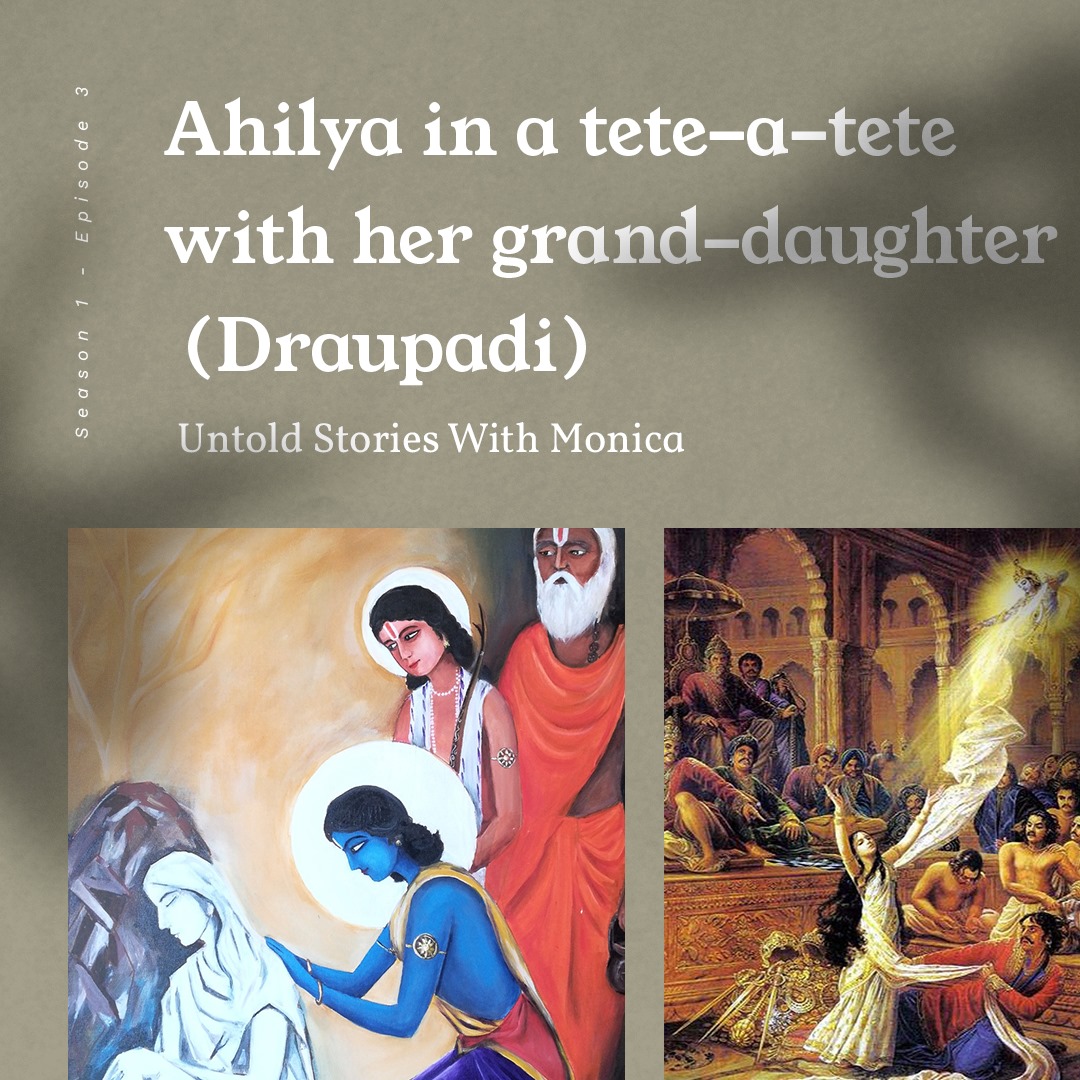
  • Ahilya in a tete-a-tete with her grand-daughter (Draupadi).

    Ahilya in a tete-a-tete with her grand-daughter (Draupadi).

    After having shed her human form and entering the world of souls, Ahilya was relaxing in Swarg Lok. It was a place without the manifestation of time and space.

    “Look! What I got for us, Dadi.”

    Draupadi walked in holding a tray with two glasses of refreshing drinks. She looked at Ahilya with admiring eyes.

    “You are the masterpiece of Lord Brahma. Your beauty is flawless. Your facial features and body, well-shaped and sculpted, so apt to your name, Ahilya. You are certainly the most beautiful woman Earth ever had,” she complimented her grandmother.

    Cupping Durapadi’s chin in her palms, Ahilya praised her,

    “And the tej of your face still makes you the most radiant one. The perfect symbol of fire.”

    Hugging Ahilya, Draupadi continued, in a reflective mood,

    “You know Dadi, though we were born in different yugs, related as cousin grandmother and grandchild, somewhere our journeys were filled with similar challenges. Our destinies subjected us to the same atrocities by society.”

    “And what makes you say that, Draupadi?” Ahilya sounded intrigued.

    “Your character was tainted with infidelity. Your short encounter with Lord Indra led to severe punishment of several years by Maharishi Gautama. He accused you of vanity. You were turned into a stone. You had to practise rigorous penance for purification. You were looked down upon for years. Everyone turned away their eyes from you as if you were invisible. Why didn’t your creator, Lord Brahma, come to your rescue even once? If not that, at least he could have come to hear your heart. To share his part of the fault- of marrying away his most beautiful creation, an innocent girl, to an old ascetic. To acknowledge his failure, to see that this mismatch could lead to such incidents in the future. Even he was at fault for being thoughtless. It was only Ram who could see you as a human. Humans who could falter and be flawed. Only when his feet touched you and when he accepted your hospitality did everyone begin to acknowledge you. Only after he saw you, did you become visible again. Isn’t this a bit too harsh treatment from our loved ones?”

    Draupadi continued as Ahilya listened silently,

    “Similarly, I was married to the Pandavas, became the wife of 5 husbands. A choice I didn’t even make. I was character assassinated various times, by numerous people. Everyone called me names, either aloud or in hushes. They looked down at me. Saw me as an angry fireball. Despite being a wife of 5 yodhas, a daughter in law of magnanimous Kingdom of Hastinapur, before powerful ancestors, I was humiliated, my dignity was raped publicly. And like in your case, who came to my rescue? Krishna! It was Govind, who dared to stand against all. Only he came forward and wrapped a bandage around me. Only he saw me beyond what everyone could and accepted me as a Sakhi (friend). Just like Ram, he saw the human in me. Isn’t it strange Dadi that our loved ones, nearest and dearest ones can’t see us the way strangers can?”

    Heaving a sad sigh, Ahilya replied,

    “Yes, it’s strange. But it’s also a reinforcement of God’s presence. In whatever humanly form.”

    Mata Lakshmi, who was overhearing the conversation outside, walked in. Taking a sip from Ahilya’s glass, she joined in the talk,

    “Shri Ram came and rescued Ahilya, for he had to show the world that forgiving is a Godly act.”

    Then taking her gaze over to Draupadi, Lakshmi continued,

    “Lord Krishna never judged you for being a wife of five husbands and accepted you as a Sakhi. Because in the new Yug, he had to set the norm of gender equality. If men could indulge in polygamy, so could a woman, if needed. He also had to introduce a new relationship. Of that of a friendship between a male and female.”

    Mata Lakshmi’s words, sealed the conversation well. Happily, gulping down the thoughts and drinks, Lakshmi, Ahilya and Draupadi giggled and posed for a selfie together.

  • KARNA’S ARROWS OF QUESTIONS ON KUNTI

    Karna’s Arrows of Questions on Kunti.

    Karna pleaded in a broken and an acidic tone,

    “Tell me Rajmata Kunti, how do you have the right to call yourself my mother? Why should I see you as my Mata? What have you done so far to deserve this title?”

    Kunti collapsed on her knees, for she had no answers to this child’s questions. Although a grown up legendary warrior now, his questions were revealing a toddler….. His oddity was justified….. No words came out of her mouth. Only guilty tears flowed.

    He continued brashly,

    “Even Krishna was born out of Devaki and raised by Yashodhra. Yet he is addressed as Devaki Nandana. You know why? Not only because she held him in her womb for months but also because she let go of him for his safety, and not for her own protection. That is a courageous act, isn’t. But you, Pandu Jananni, were coward to accept me, and more coward to not kill me. Instead of discarding me away in the river, you should have killed me. At least my birth wouldn’t have been shamed. That death would have been better, than this life filled with dilemmas about my belonging and birth.”

    Kunti retorted,

    “YES! YES! I was a coward. I still am one. That is exactly the reason why I come to meet you in hiding even today. I accept your accusations Putra. But please for god sake, please come to me now. I am standing here with open arms to embrace you, ready to face all. I want to announce you as my first born, my eldest son.” Pleaded Kunti.

    “DON’T! PLEASE don’t call me your son. I am Radhey. Radha MA’s son. My heart is filled with memories of her. It was she who ran her fingers on my cheeks to wipe the tears. Those were the hands that ran on my forehead to sooth the creases of tensions. Her delicacies have built these muscles. And above all, those were her prayers which were filled with my name. It makes me wonder Rajmata, how do these tears flow from your eyes? Is your mind conditioned to evoke emotions when it hears the word Mata? Don’t fake it Rajmata. Motherhood isn’t an entitlement. It’s a journey to be lived and felt and above all to be shared. Without knowing the dharma of a mother, without performing any Karma of a mother, you want to be my Mata now. Please call me Karan, that’s my name for outsiders.” Karna shrugged her as a mother.

    “I was a young girl putra. I didn’t have the courage to face the world as a single, unwedded mother. It was my curiosity that led me to test Rishi Durwasa’s divine mantra. That I could summon any God with the Mantra jaap. I didn’t know what to do my child. I am sorry! I am really sorry!” Kunti sobbed.

    Hearing her reasons, Karna mocked,

    “So I am actually a result of an experiment. Right? Isn’t this too harsh to hear Rajmata? And now after years you want the entitlement to the result of that experiment. Standing at the threshold of Kurukshetra war, you suddenly want to accept me as a son. Isn’t this far from truth? Doesn’t this request display your love for your five sons and not me? Why are you here? To accept me as a son…..give me the throne of Indraprastha or to save your sons from being killed by my arrows…. Please go away Rajmata. This Daanvir Karna has nothing to offer you except the rain of his questions.”

  • SITA SPEAKS TO HER SAKHI (FRIEND)

    Standing before the mirror, Sita ran her fingers through her cascading hair.

    “Look at that lovely hair! I have always envied you for them.” Joked Sita’s Sakhi as she walked into her chamber in Swarg loak.

    Surprised by the unannounced arrival, Sita reached out to hug her beloved Sakhi. Seating with her on the couch she bemused,

    “What a pleasant surprise! How have you been Sakhi?”

    “What can possibly be wrong with me, who has a friend like you?” Sakhi replied with pride.

    Having met after a long time, they both exchanged pleasantries, enquiring about each other’s well-being. Sakhi then stood up and walked around the chamber thoughtfully. Sita’s gaze followed her. Comprehending that her Sakhi had something to say but was hesitant to do so, Sita touched her Sakhi’s shoulder.

    “Sakhi, please speak your heart. You can share anything with me, dear. Isn’t that how friends are?” Eased by her words, Sakhi placed her hand on Sita’s.

    “Sita, we all know that during your exile years with Lord Ram, you were abducted by Asura Ravana. We all know about the atrocities inflicted on you. The trauma you went through. But there has been a thought that has always made me wonder. Was it really an abduction or your will in disguise?”

    Stirred by the question, Sita began fidgeting with her dress. She countered it with another question.

    “What makes you see my abduction as a disguised Will Sakhi?”

    “At the tender age of 9 years, Sita you could lift the supreme Pinaka (the bow of Shiva). The same bow, at your Swayambar, Mahabali Ravana, in his prime and powerful youth, couldn’t even move, forget about lifting it. Isn’t this evidence enough of your Shakti?… Of your supremacy over him?….. And when he came to kidnap you, all you did was push him?…. You were obviously more powerful. Then why did you allow it to happen? You could have easily reduced him to dust there and then. Even after having read all the scriptures on Ramayana, written by great sages, this mystery remains unresolved. Only you can open your heart and answer this. I am here to hear it from you.” Smiling as her Sakhi’s smartness, Sita replied,

    “Yes! It was a disguised will. For my Dharma then, was not to fight but to be the Shakti of Lord Ram….  For it was not my purpose of descending on Earth…. That purpose was Ram’s, Vishnu’s avatar to abolish the asuras, and lay the foundation of a cultivated form of society…. To kindle the new Dharma of righteousness….. My purpose was to be the reason behind the action, not the action itself Sakhi. If I had not been abducted, 

    How would the legendary Jatayu prove his devotion to me and Lord Ram? 

    How would the Vanaras (The animal community) rise above their animal instinct and fight for justice? 

    How would Vibhishana practice the choice between right and evil? 

    And above all, how would Lord Ram, born as a Kshatriya find a rightful reason to annihilate demon Ravana? 

    For according to Kshatriya Dharma, without an evil deed, a weapon can’t be raised against an enemy. So my dear friend, though I was a Shakti, the manifestation of my power lay, in supporting my Lord Shri Ram. To amalgamate my powers with him and fulfill our purpose of incarnation.”

    Having received a satisfactory answer to her burning curiosity, the Sakhi happily hugged Sita. Her eyes glistened with tears of undying love and pride more than ever.

  • AKHILANDESHWARI- THE GODDESS OF NEVER NOT BROKEN

    On the dark skin, the unruly hair covered her face partially and flew in the wind like smoke. The Shakti’s eyes were oozing wrath today.  Her anger was
    inducing havoc on earth causing destruction. All of sudden, her wrath changed to grievous sob, resulting in a downpour of rain. The land flooded, washing away people, flora and fauna. She sneezed, the air got infected with diseases. Holding a trident in hand, adorned in dark coloured clothes, driven by her unruly emotions, with broken energies, Shakti moved around the earth.  Her moods, manifested on the earth’s condition, for she was a Parvati’s Swaroop (form), known as a Shakti.

    One day, Shakti with her usual wavering mind was strolling beside a river.
    Water splashed behind her. A huge crocodile emerged from water to sun soak on land. Driven by her uncontained reactions, fearsome, she immediately charged her trident, piercing the animal to death. Seated in his heavenly abode, Lord Shiva’s forehead wrinkled. He felt disturbed, witnessing the scene, the state of Earth and more so this form of Parvati’s Shakti. After a thoughtful moment, Shiva made a pair of earrings with a chakkar design on it.  Descending on Earth, the Shankara (earthly name of Shiva) gifted the earrings to the Shakti, seated her on the bank of Cauvery River and proposed.

    “Devi! Please sit in the Sat-Chit-Ananda pose until I return.”

    The chakkars on the earrings trapped her energy and by the mellowing effect of the suprema’s voice, she did as asked for. She sat in this yogic mudra for months. She travelled within, with this practice. Years passed, Shiva looked below at the Shakti. Her raised eyebrows had eased. The creases on her forehead disappeared. The dark-skinned face bore a serene look. The cheeks looked fresh, without the dried tears. The earth was flourishing.  It was time to meet her once again.

    Seated facing each other, like a teacher and disciple, Shiva awakened her from the trance.

    “Devi please open your eyes.”

    After paying her reverence, she looked around the transcended earth. It was matching her inner world. It was flourishing, at peace. In an enlightened voice, she shared,

    “I have acknowledged my fears, my broken energies. Now I neither fear them nor let it control me. I accept them as my own. I also know now, that the concept of the whole and absolute are illusionary. Like the world, even we are in a constant state of flux. Hence instead of resistance, we must be driven with acceptance. This acceptance now compels me to flow. This brokenness is my whole. I am at peace now.”

    Just as she finished speaking, a crocodile appeared in the water. Unlike her
    previous self, driven by fear. This time, the Shakti dived into the water. She
    swam with the flow of water. She saw the bodily movement of the beast,
    matched her motion with it. Hence by doing so, she stood atop it. Like a
    victorious goddess, she rode across the river, balancing herself on it.


    Shiva smiled at the sight.

    “Hail! Akhilandeshwari. The Goddess of never not Broken.”

    Written By Monica Gupta

  • The story of Vinayaki – The Elephant Headed Goddess

    “VINAYAKI!!!!!”

    Vinayaki’s ears extended, her hand stopped mid-air as she was reaching for another modak.

    “It is Mata Parvati’s call. I hear some major trouble in her voice.” Vinayaki sprung up from her relaxed cross-legged posture. Her pot-belly falling on the feet of her vermillion coloured body. She blew a conch held in her left hand to assure Parvati that she was on her way.

    As she reached the spot, she saw Mata Parvati in a perplexed state.

    “What is the matter, Mata? What can be the cause of worry to a Supreme Shakti like you?” inquired Vinayaki, bowing down to pay her reverence.

    Speechless, Parvati’s head turned towards the left, eyes 45 degrees. Just then, standing akimbo, with hands-on her toned hips, Vinayaki saw Shiva appear in his gigantic form. In his outstretched right arm, he held his Trident like a trophy with an impaled Asura Andhak on it, nearly touching the sky. The drooping body was oozing blood drops like rain. Vinayaki let out a burst of satisfactory laughter to warn everyone against laying their lustful eyes on Mata Parvati, anyone doing so
    deserved no other death than this.

    Andhak had misused his blessing of immortality bestowed by Lord Brahma, forgetting Brahma’s words, “Anyone born has to die. If ever he harboured lustful feelings towards a motherly figure, his death will be inevitable.” Having become immortal, Andhak had expanded his empire by inflicting cruelty on asuras and devas as well. And now that as he had tried to abduct Parvati to marry her, he
    rightly deserved a bloody death.

    “Now that the beast is dead, why is Mata Parvati still worried?” Vinayaki thought as she ambled around.

    Squeezing her eyes, she bent a little and immediately stamped on an ant-like creature crawling on the ground. It wasn’t an ant, but a tiny replica of Andhak. Furthermore, to her astonishment, she noticed every drop of Andhak’s blood falling on the ground birthing another Andhak. Vinayaki, swift yet steady, with the weight of her heavy body began stamping on Andhak’s miniatures. Being the goddess of wisdom, she could assess that the situation couldn’t be dealt with alone.

    “Mata! Please call for the other sister Shaktis,” she requested Parvati.

    By now she had also figured out that the only way to stop the birth of more Andhaks was to stop the blood drops from falling on the ground. Swinging down her Parshu, she axed these numerous creatures, crushed them under her feet, and simultaneously rolled, twisted and extended her trunk to quickly suck in the blood drops.

    “No, don’t Vinayaki! What if the blood of this brute infects you?” Parvati tried to stop her.

    “I am the feminine energy of Lord Ganesh. He is a Dev Mata. Birthed by you. These little bad-blood drops cannot harm me. You please don’t worry. Immediately summon the other Shaktis.” In a flash, Indrani emerged as Indra’s Shakti, Vaishavi as Vishnu’s Shakti and Brahmini as Brahma’s Shakti. Watching Vinayaki in her courageous deed, they exchanged a look of pride. Vinayaki, the Vighanharta (remover of obstacles) had yet again wisely resolved the problem. Following her, all the Shaktis swirled like a cyclone around Shiva, and in no time, drank every blood droplet until the Asura ran out of blood. At last, Vinayaki blew aloud the trumpet of victory.

    “Har Har Mahadev!”

    Known by the names of Ganeshani, Gajanani, Ganeshwari, Gajamukhi, and Vigneshwari. Vinayaki is an elephant-headed goddess. Her iconography and mythology are not very clear due to the lack of written scriptures. Though associated with the name of Lord Ganesh, she is not his consort but an independent Shakti herself. The feminine energy of the lord of wisdom. Vinayaki is also seen as a part of the 64 yoginis or the Matrika goddess in various Puranas. Every month, the fourth day after the new moon is observed as ‘Vinayaki Chaturthi’. Since her stories were mostly oral, they were lost over time. Her birth and origin are also unknown. The artist Mahen Chanmugan who focuses on paintings of Lord Ganesh says that “the earliest evidence of a female Ganesh or Vinayaki is a weathered terracotta plaque from Rairh in Rajasthan, which dates back to the first century.” Various other temples in Karnataka, Orissa, Kanyakumari and the East also have sculpture representing the female avatar of Ganesha.

    Written By Monica Gupta